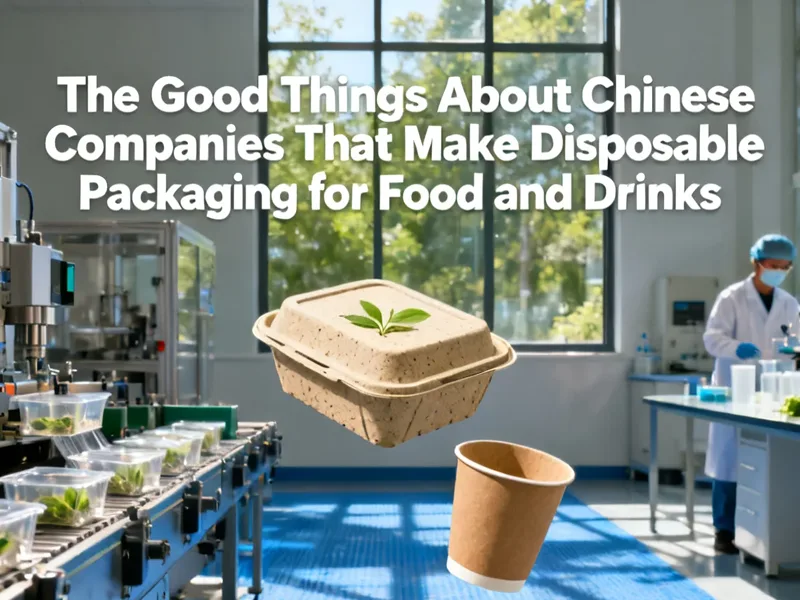
The good things about Chinese companies
1. The complete industrial chain offers big savings.
- China has the world’s most complete disposable packaging industrial chain. This means that they start with raw materials (like pulp, PLA, and PBAT) and make finished products and then send them out to other countries.
- In 2022, China was responsible for 40% of the world’s production of pulp molding and almost 70% of the disposable tableware sector. This shows that China is the world leader in these areas.
2. Exceptional ability to manage costs
Here are some ways Chinese companies can save money:
- Substituting raw materials For example, Zhongxin Co., Ltd. replaced dry pulp with wet pulp, saving over 500 yuan per ton of pulp material.
- Energy Optimization: Switching to biomass boilers instead of fossil fuels cut energy costs by over 500 yuan per ton.
- Automation Upgrades: Technology improvements in equipment lowered labor costs, saving about 10% overall and helping gross margins exceed those of similar companies.
3. We have the best technology and production capacity.
- Chinese companies have made big advances in important technologies like making pulp, lamination with PLA, making many layers at once, and biodegradable materials. They can make a lot of these things at the same time and keep them stable.
- Companies in China are experts at making eco-friendly products like pulp-molded food containers, PLA-laminated paper cups, and biodegradable food bags. Major companies like Zhongxin, Shaoneng, and Yutong Technology can make all types of products automatically.
4. Responds quickly to changes in the environment and adapts its policies easily.
- China’s “plastic restriction” policy led domestic companies to use biodegradable materials like PLA, PBAT, and pulp molding, giving them an early advantage.
- By 2022, biodegradable plastics had taken 18% of the Chinese packaging market, and this number is still growing.
- Chinese companies quickly follow environmental rules in markets like North America, Australia/New Zealand, and the EU. They supply products that meet standards like ASTM D6400, EN13432, and AS4736.
5. They can sell products in other countries very well and their customers are very loyal.
- In 2023, China exported more than $20 billion worth of single-use plastic packaging products. The most popular products were molded pulp food containers, PLA paper cups, and kraft paper bags.
- Chinese companies have worked with well-known international brands like Starbucks, McDonald’s, Tim Hortons, and Uber Eats for a long time. This shows that they can deliver products and services all over the world and follow the rules in other countries.
6. We have a wide range of products that can be customized to fit your needs.
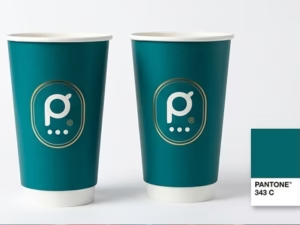
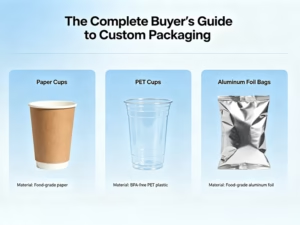
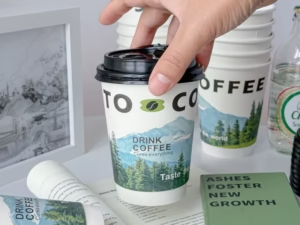
- Chinese enterprises offer customized products that can be made to order. These products come in many different types and features. They are made with a variety of materials and printed in different ways. This makes them suitable for many different uses, including food service, coffee, baking, takeout, aviation, and pre-cooked meals.
- They can make small amounts of products quickly or a lot of products automatically. They can also make products in different ways based on what their customers want.
A comparison of the disposable packaging industries in China, Vietnam, India, and Mexico (2025 edition)
1. China
Cost Structure:
It costs the least money worldwide to make products because we use less energy, labor, and raw materials. We can reduce costs by over 10% by using automation.
Technical Capabilities:
We are the world’s top experts in making things out of pulp, and we’re also really good at putting together different layers of materials using a process called “multi-layer co-extrusion.” We can even make things that break down into the earth naturally. And we’ve got most of the equipment we need to make all of this happen right here at home.
Integrity of Industrial Chain:
This is the most comprehensive global portfolio, covering 97% of major manufacturing categories. It delivers end-to-end solutions, from pulp and PLA to finished products.
Production Capacity Scale and Efficiency:
Pulp molding makes up 70% of how much is produced around the world. New factories will be up and running in 12 to 18 months, and they will be used more than 80% in the first year.
Environmental Compliance Capabilities:
The company quickly followed the rules set by the FDA, EN13432, and AS4736. More than 35% of the products it sells are green.
Market Positioning and Customer Loyalty:
We work with some of the world’s most famous brands, like Starbucks, McDonald’s, and Tim Hortons. We can customize our products to fit their needs.
2. Vietnam
Cost Structure:
Labor costs are lower than in China (about $4/hour), but 70% of raw materials come from China. This is offset by higher transportation costs and tariffs.
Technical Capabilities:
The main focus is on assembly, and the core equipment is imported from China. The technology is not changing quickly.
Integrity of Industrial Chain:
It depends a lot on Chinese goods, and imports of these goods from China increased by 18% in 2023.
Production Capacity Scale and Efficiency:
The factory can only make a limited number of products, but it’s almost at its maximum capacity. The number of orders it can take is almost reached.
Environmental Compliance Capabilities:
It can only make low-end orders, doesn’t have the ability to get environmental certification, and needs support from its Chinese parent companies for exports to Europe and the US.
Market Positioning and Customer Loyalty:
These factories mostly serve as backup for Chinese companies, and their customers aren’t very loyal. Orders can also change a lot.
3. India
Cost Structure:
Labor costs are the lowest (less than $3 per hour), but high electricity/logistics expenses and low yield rates result in overall costs that are higher than those in China.
Technical Capabilities:
The country is behind the times in technology, and only 5% of the market uses eco-friendly products. Biodegradable food containers cost 30% more.
Integrity of Industrial Chain:
Supply chains are broken up, which means that even imported cardboard labels are used. This leads to very low localization rates.
Production Capacity Scale and Efficiency:
The government is making a big deal out of the situation, but the market isn’t really responding. Factories often stop production because they don’t have enough power or materials, and they’re only using less than 60% of their production capacity.
Environmental Compliance Capabilities:
The government is not doing a good job of enforcing environmental policies related to the home. Only 5% of products are made from bio-based materials. Exports to Europe and America often face certification barriers.
Market Positioning and Customer Loyalty:
It mostly serves low-cost markets in the Middle East and Africa, with a few clients in Europe and America.
4. Mexico
Cost Structure:
Labor costs are between China and Vietnam ($6/hour). Logistics are expensive (containers cost $3,000 more than in China), and most raw materials are sourced from China.
Technical Capabilities:
It has moderate technical capabilities, and it’s very good at simple assembly. Complex products (like PLA-coated films) depend on Chinese technology and materials.
Integrity of Industrial Chain:
The local supply chain can only meet 30% to 40% of demand. More than 60% of demand is met by foreign investment. The main raw materials come from China.
Production Capacity Scale and Efficiency:
The factory is not getting bigger as fast as it should (it will take 24–36 months to build). There aren’t enough skilled workers, and the factory isn’t being used as much as it should in the first year.
Environmental Compliance Capabilities:
It can make basic products, but high-end eco-friendly products (like PLA food containers) still need Chinese technology and materials.
Market Positioning and Customer Loyalty:
It relies on U.S. “nearshoring,” which means it performs simple assembly, but it has a high concentration of customers and weak bargaining power.
Here’s what we can conclude:
China is the only country that has all three of these capabilities. Vietnam, India, and Mexico only have some advantages in certain areas, like labor or tariffs. They cannot pose a systemic challenge.
Ready to upgrade your shelf? FHQPAK.com ships 40+ billion food-service disposables out of China every year—fully certified, fully custom, fully trackable. Hit the “Get Quote” button or email [email protected] with your target SKU and monthly volume; our bilingual team will return a landed-cost breakdown and a free digital mock-up within 24 hours. Let’s turn your next container into a best-seller—one cup, lid and straw at a time.