FHQPAK——small-batch plastic cup supplier outperform bulk-only factories.
Your seasonal bubble tea menu goes live in six weeks. Recipes locked, staff briefed, POS artwork approved. Then your cup supplier revises the shipment estimate to week nine — conditional on a 30,000-unit commitment. You’re sitting on surplus stock from last quarter and short on the one format the new menu actually needs.
That compression between menu cycle and supply lead time is where most packaging relationships quietly break down. The product itself is rarely at fault. What fails is a supplier whose production model was engineered for volume stability, not the short-run velocity that drives modern foodservice margins.
Packaging procurement has shifted from a cost-reduction exercise to a competitive lever. A misaligned supplier doesn’t simply inflate your unit cost — it erodes launch windows, inflates working capital tied to dead inventory, exposes you to food safety liability, and hands market timing to competitors who move faster. This guide maps seven operational failure points that distinguish capable suppliers from those who look credible until the relationship is tested.
No food-grade certifications — or they can’t produce them on request
In food-contact packaging, certifications are not documentation formalities — they are the condition under which a supplier can legally ship to your market. A factory that hedges on compliance language or cites a general ISO audit in place of food-contact-specific test reports has disclosed its actual compliance posture. Walk away before you’re the one explaining a product recall to your retail buyer.
What certifications to require and how to verify them

For US-bound product, FDA 21 CFR governs plastic food contact materials — specifically Parts 177 and 178 for PET and polypropylene. For the EU, EU Regulation (EC) No 10/2011 sets migration limits for plastic food contact articles; LFGB §30/31 (the German food contact standard) functions as a higher-bar proxy that many global buyers now require regardless of destination market. BPA-free declarations are non-negotiable for PET cups in any credible commercial relationship.
The distinction that separates serious suppliers from certificate-holders: batch-specific test reports versus a static compliance certificate. Request batch-specific migration test results and Material Safety Data Sheets (MSDS) broken out by substrate — paperboard, PE coating, PET resin, and lid polymer each carry different risk profiles and require separate documentation. A certificate dated more than 18 months ago, covering a product line rather than a specific production run, tells you the supplier passes audits but does not actively track compliance across changing resin sources.
Paper cups vs. PET cups: divergent documentation requirements
Single-wall and double-wall paper cups require migration testing for both the paperboard substrate and its PE or water-based barrier coating — two distinct material declarations. PET cups require resin-grade purity documentation under FDA 21 CFR §177.1630, with particular scrutiny on acetaldehyde migration where the cup will contact acidic or high-sugar beverages. When consolidating both cup types under one supplier relationship, audit certifications against each product line independently — a supplier certified on PET is not automatically compliant on paper.
Rigid MOQs with no flexibility for small or trial orders
$1.7Tthe estimated global cost of inventory distortion in 2025 — the combined impact of overstocking and stockouts that flexible MOQs help prevent.
The high-volume packaging model made commercial sense when menus were stable, SKU counts were manageable, and demand forecasting had a six-month horizon. None of those conditions hold for most foodservice operators today. Chains rotate seasonal specials every 8–12 weeks. Independent cafés test three cup formats before committing to one. Ghost kitchen operators spin up and discontinue concepts faster than any 10,000-unit minimum can accommodate.
A supplier anchored to high MOQs isn’t protecting their margins — they’re externalizing inventory risk onto you. Every overcommitted pallet represents tied working capital, storage overhead, and the compounding likelihood that a menu revision makes the stock partially or entirely unsaleable.
What “flexible MOQ” actually means — and how to probe it
A supplier who genuinely operates on flexible minimums has configured their production scheduling and costing to absorb short runs without penalty repricing. The test is precise: ask for per-unit pricing at 1,000 units and at 5,000 units for the same 90mm PET cup. A price spread under 15% indicates a production system built for variable run lengths. A spread above 30% means short runs are being cross-subsidized — the supplier tolerates them but hasn’t invested in making them viable. That gap compounds with every reorder.
How FHQPAK structures thisFHQPAK’s standard case pack across its full PET and paper cup range opens at 1,000 pcs/carton — the threshold at which small-batch procurement becomes operationally rational rather than a premium exception. Mixed-diameter consolidation across 78mm, 90mm, 93mm, 95mm, and 98mm SKUs into a single shipment is supported, compressing both freight cost and the administrative overhead of managing multiple purchase orders.
Response time over 4 hours — a signal of deeper operational problems
Response time functions as a proxy metric for organizational bandwidth — specifically, whether a supplier has staffed and structured their customer-facing operations to match the pace at which problems actually arrive. B2B platform data consistently correlates sub-4-hour response times with on-time delivery rates above 95%. This isn’t a coincidence of correlation; it reflects the same underlying investment in operational process.
A factory that takes 36 hours to return a pricing inquiry operates its production scheduling, QC escalations, and logistics coordination at the same tempo. When a shipment runs three days late and you need a revised ETD to pass to your operations team, that tempo becomes your problem.
How to pressure-test responsiveness before you issue a purchase order
Send a deliberately layered inquiry on a Tuesday morning: “We’re evaluating a 3,000-unit order of 90mm PET cups at 380ml capacity, BPA-free certified, with matched injection-molded lids in black. We need production lead time, ex-works unit price, carton dimensions, and G.W. per carton.” Track the time to first substantive reply — not acknowledgment, but a reply that addresses all four items with specifics. A supplier who returns that response in under two hours with no items missing has demonstrated the organizational reflex that scales to execution.
Cross-timezone coverage for international buyers
China Standard Time runs 12–16 hours ahead of North American time zones. A supplier without a designated export team working overlap hours — or a structured handoff protocol — will respond to your Tuesday afternoon inquiry on Wednesday evening GMT+8, which reaches you Thursday morning. That’s a two-business-day lag built structurally into every exchange. Verify whether the supplier has allocated staff for Western-market hours, not just whether they claim to.
Quality “fade” after the first order — the golden sample problem
Every experienced import buyer has encountered this: the pre-shipment sample is clean, dimensionally accurate, and optically clear. Production run one ships on time and performs well. Run two, six months later, is marginally off — nothing you’d reject outright, but the lids seat slightly looser. Run three, you’re fielding complaints from store staff about cups deforming under drink weight. By the time the pattern is visible, the supplier relationship is entrenched and switching costs are real.
Where dimensional drift materializes in cup products
The most commercially damaging variant is top-diameter migration. A 90mm cup whose rim drifts to 91.5mm will no longer retain a snapped lid reliably — a failure that surfaces at the counter, not in your receiving dock. Wall-gauge reduction is subtler: a 0.05mm decrease in PET wall thickness is invisible to incoming inspection but accelerates deformation under the thermal load of a cold condensation environment and under the mechanical load of a full stacked carton during transit. These aren’t manufacturing accidents; they’re the predictable output of a production system that substitutes resin grade or wall thickness to defend margin when input costs rise.
How to close the contractual and operational gap
Hard-code dimensional tolerances into your purchase order — not as a courtesy specification, but as acceptance criteria. For a standard 90mm PET cup: top diameter 90mm ± 0.3mm, bottom diameter 60mm ± 0.3mm, height 84mm ± 0.5mm, wall thickness minimum 0.28mm. Require a production-run pull sample — drawn from the actual production batch, not a pre-production prototype prepared specifically for approval — for any order exceeding 5,000 units. For sustained high-volume relationships, periodic third-party inspection through Bureau Veritas or SGS shifts the quality verification burden off your receiving team and onto a neutral technical party with no incentive to pass marginal stock.
Lid compatibility at FHQPAKFHQPAK production-tests lids against cup rims within the same diameter family — coffee lids and injection-molded lids for 90mm cups are validated against actual production stock, not matched nominally. Buyers can pull a lid-cup compatibility kit before committing to bulk volume, removing the risk that a diameter assumption creates a service-line problem six weeks into a contract.
No transparency on lead times — or lead times that keep changing
A supplier who quotes lead time in ranges — “roughly three to four weeks, depending on our schedule” — at the point of order confirmation has revealed that they don’t control their production queue. That ambiguity doesn’t protect you; it transfers forecasting risk from their planning department onto your operations. When you’re coordinating a product launch across packaging receipt, staff training, and marketing activation, “depending on our schedule” is not an answer you can build a Gantt chart around.
Calibrated benchmarks for plastic cup lead times
For standard-specification stock sizes, a competent Chinese manufacturer committed to the order should hold to 10–15 production days from PO confirmation. Non-standard prints or custom dimensions extend that window by 5–10 days to accommodate plate or tooling preparation. Transit adds 30–35 days sea freight to the US East Coast, 25–30 days to Northern Europe. Express air compresses that to 5–7 days but lands at 4–6× the freight cost — viable for urgent reorders, not as a standard operating model.
Always decompose the lead time figure a supplier quotes: production lead time ends at the factory gate; delivery lead time ends at your dock. The gap between those two figures — port handling, customs clearance, last-mile — belongs in your buffer calculation, not the supplier’s. Most factory quotes address only the former.
Menu agility requires supply agility at the same clock speed
A summer cold-brew lineup has an 8-week commercial window. A supplier whose reorder cycle runs 8 weeks of production plus 5 weeks of sea freight is structurally disqualified from serving a menu-driven account — regardless of unit price. The economics of rapid-response supply, built around shorter runs and higher shipping frequency, only make sense if the supplier has engineered their production for that cadence. Ask how many short-run orders they fulfill per month before accepting a lead-time commitment from a factory whose core business is 50,000-unit annual contracts.
Single-source dependency with no supply chain resilience
The supply disruptions of 2020–2022 forced a reckoning that many procurement teams subsequently forgot as conditions normalized. Single-factory dependency felt defensible when that factory performed consistently; the risk only materialized when Chinese New Year coincided with a raw material shortage, or when a port congestion event stacked on top of a production backlog. The businesses that absorbed those disruptions cleanest were those who had maintained a secondary source — not because they expected to use it, but because they understood that concentration risk doesn’t telegraph its arrival.
The 2025–2026 tariff environment has added a structural variable that concentration risk models didn’t historically need to price. A supplier manufacturing exclusively in one region with no documented contingency capacity is now carrying regulatory risk on your behalf — and not disclosing it in their pricing.
Consolidation as a diversification strategy
Supplier diversification doesn’t require managing five separate vendor relationships with five separate quality audits and five separate payment terms. A more executable approach: source multiple product categories — PET cups, paper cups, lids — through a single supplier who carries a full-format range. This consolidates logistics and commercial management while distributing category risk. Separately, maintain a qualified backup for your single highest-volume SKU. You may never activate it. The point is that you’ve already completed the audit, negotiated terms, and run a trial order — so activation takes days, not months.
No sampling program before bulk commitment
A supplier who resists sample orders — or prices them at a level designed to discourage the request — is communicating that they’ve calculated a higher probability of buyer dissatisfaction than they’re willing to absorb. Experienced suppliers welcome sampling precisely because it front-loads the qualification process, filters out buyers whose specs they can’t meet, and accelerates the path to purchase orders from those they can. Friction around sampling is diagnostic.
What a rigorous sample test actually requires
Visual inspection at ambient temperature tells you almost nothing useful. Fill PET cup samples with the actual product — the specific beverage, including its acidity, fat content, and temperature — and refrigerate for 24 hours. Evaluate optical clarity after thermal cycling, lid seal under finger pressure on a full cup, and rim deformation when the cup is gripped with normal handling force. Stack 50 cups under the compression load of a full carton and hold for 48 hours; check for rim cracking or sidewall creep. For paper cups, conduct the hot liquid soak test: fill to 80% capacity with 80°C water and hold for 15 minutes. Seepage, delamination, or rim softening under those conditions will recur at the counter. Record every result against the supplier’s written specification — not against your visual impression of “good enough.”
Questions during sampling that surface a supplier’s actual capabilities
Three questions separate producers from traders during the sample phase. First: “Are these samples pulled from current production inventory, or fabricated specifically for this evaluation?” A supplier who can only provide bespoke samples — not stock — may lack the production depth to fulfill consistent reorders. Second: “What is the documented wall thickness tolerance for this run, and can you provide the incoming resin test report?” Third: “What is your rejection rate on this SKU in your most recent production quarter?” A supplier who answers the third question with specifics rather than deflection has a quality management system worth trusting.
FHQPAK’s sample protocolFHQPAK draws samples from active production stock — not from pre-production batches prepared for evaluation. Multi-diameter sample kits covering the full 78mm–98mm PET range plus matched lids are available for buyers auditing a supplier transition or validating a new format. Contact us to configure a kit against your specific cup-lid pairings.
Supplier evaluation scorecard
Run any prospective supplier through these seven criteria before issuing a purchase order. A single hard failure — documentation withheld, sampling refused, lead time unconfirmed at PO — is sufficient grounds to disqualify. Weak answers on two or more criteria compound into a relationship that will cost more than the per-unit savings justify.
| Criterion | What to ask | Pass | Fail |
|---|---|---|---|
| Food-grade certification | Can you provide batch-specific FDA / LFGB test reports? | Documents provided within 24h | General cert only, or delayed response |
| MOQ flexibility | What is your MOQ and price per unit at 1,000 units? | 1,000–2,000 pcs at fair pricing | 10,000+ minimum, no exceptions |
| Response time | Time your first specific inquiry | Specific answer within 4 hours | Generic reply after 24+ hours |
| Quality consistency | Can you share dimensional tolerances in writing? | Written spec with tolerances provided | Verbal assurance only |
| Lead time clarity | What is your production lead time for this SKU, confirmed at order? | Specific days, committed in writing | Vague range, “depends on capacity” |
| Supply resilience | Do you supply multiple product categories from the same facility? | Full range: PET, paper, lids | Single product type only |
| Sampling program | Can I order a mixed-diameter sample kit before committing? | Yes, at reasonable cost and timeline | No samples, or MOQ applies to samples |
Frequently asked questions
Frequently asked questions
A credible plastic cup supplier should hold food-grade certifications relevant to your target market. For the US, FDA compliance (21 CFR) is the baseline. For the EU, LFGB and EU Regulation 10/2011 on plastic food contact materials are required. BPA-free documentation is standard for PET cups. Always request batch-specific test reports and Material Safety Data Sheets (MSDS) — not just a general certificate on file.
Industry standard MOQs for plastic cups typically range from 1,000 to 10,000 units per SKU for standard sizes. Suppliers like FHQPAK offer small-batch orders starting from 1,000 pcs/carton for both PET cups and paper cups across a full range of diameters (78mm, 90mm, 93mm, 95mm, 98mm). Low MOQs are especially important for businesses testing seasonal menus, launching new SKUs, or managing tight cash flow.
Ask the supplier directly for their on-time delivery rate — industry benchmark is ≥95%, with best-in-class at ≥98%. Request references from existing clients, check verified reviews on B2B sourcing platforms, and look at the supplier’s stated response time (≤4 hours is considered strong). During sample ordering, track the actual delivery versus promised date — this is the most reliable predictor of future performance.
Quality fade refers to a gradual decline in product quality after the initial sample or first order — sometimes called the “golden sample” problem. In plastic cups, this commonly appears as dimensional drift, thinner wall gauges, or inconsistent clarity. To prevent it: specify exact dimensional tolerances in your purchase order, request production-run samples, use third-party inspection for large orders, and establish a clear quality agreement before placing your first bulk order.
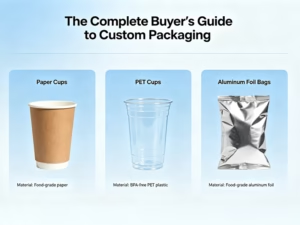
Single-wall paper cups are constructed from one layer of food-grade paperboard — lightweight, cost-effective, and suitable for cold and ambient beverages. Double-wall paper cups feature an inner and outer layer with an air gap, providing insulation for hot beverages and a more comfortable grip without a sleeve. FHQPAK supplies both in 90mm diameter, in white or kraft paper finishes, from 270ml to 400ml capacity.
PET cup selection depends on your beverage type, portion size, and lid system. Common diameter-capacity pairings include: 78mm for 150–220ml (small cold drinks), 90mm for 280–400ml (standard bubble tea or smoothies), 93mm for 200–250ml (dessert cups), 95mm for 260–380ml (specialty coffee), and 98mm for 320–400ml (large format drinks). The key constraint is lid compatibility — your lid must match the cup’s top diameter exactly.
Sample lead times from Chinese manufacturers typically range from 7 to 15 business days for standard stock sizes. Shipping adds 3–10 days depending on the method. A supplier who cannot provide samples within 10–15 business days for standard sizes may have capacity or prioritization issues that will affect your production orders as well.
Yes. FHQPAK supports mixed-SKU orders across its full product range, including PET cups (78mm, 90mm, 90mm U-type, 93mm, 95mm, 98mm), single-wall and double-wall paper cups, and matched lids. This allows procurement teams to consolidate multiple specifications into a single shipment, reducing freight costs and simplifying supplier management.
Seven criteria. FHQPAK clears all of them.
Full food-grade documentation on request. MOQs from 1,000 pcs/carton across PET and paper cup formats. Production-validated lid-cup pairings. Sample kits drawn from live production stock — not pre-production prototype