Your packaging is the first thing a customer touches. Before they taste the coffee, before they unwrap the food — they see your cup, your box, your brand, your custom food packaging. The printing method you choose determines whether your logo looks sharp and consistent, or washed out and mismatched. This guide breaks down every major printing technology used in custom disposable food packaging so you can make the right call.
Whether you’re ordering custom paper cups for a new coffee concept, branded PET cups for a bubble tea chain, or printed food boxes for a restaurant group, understanding these four printing methods will save you money, protect your brand, and help you get exactly what you envisioned.
Why Printing Quality Matters for Food Packaging
Disposable food packaging has evolved from a functional necessity into a powerful brand touchpoint. Studies consistently show that consumers form impressions of a food business within seconds of seeing its packaging — and color accuracy is central to that impression.
Consider the categories where printing quality is non-negotiable:
- Paper coffee cups & double-wall cups — the canvas your brand lives on during every morning commute
- PET & PP clear cups — where print must survive condensation, ice, and direct consumer handling
- Paper bowls & food boxes — often seen in influencer content and delivery unboxing moments
- Ice cream cups & takeaway packaging — seasonal and promotional runs where speed and small-batch flexibility matter
Color consistency directly affects brand recognition (customers recognize your brand by its exact color palette), consumer trust (inconsistent color signals inconsistent quality), and competitive positioning (premium-looking packaging justifies premium pricing).
What Is CMYK Printing?
CMYK stands for Cyan, Magenta, Yellow, and Key (Black) — the four ink colors used in standard process printing. A printing press lays down microscopic dots of each color in varying densities, and the human eye blends them together to perceive a full spectrum of color. It is the most widely used printing process in the world and the backbone of commercial food packaging production.
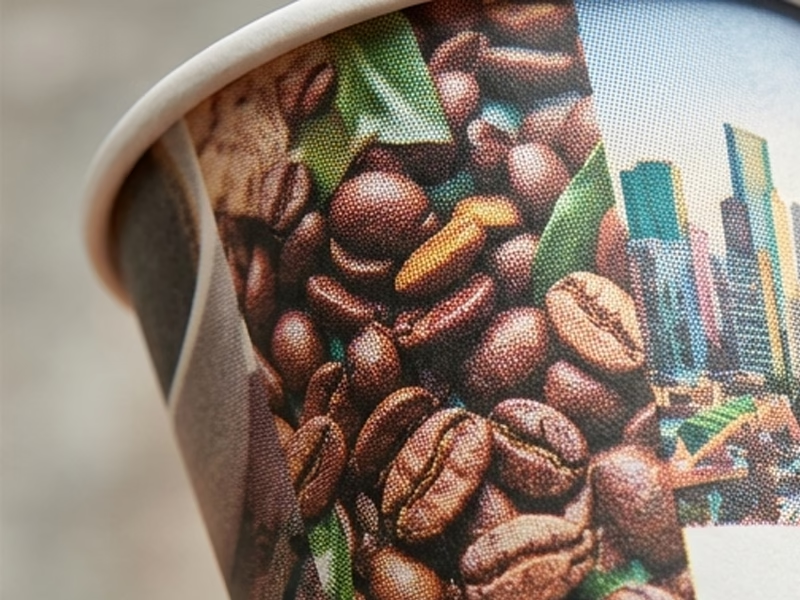
When your graphic designer hands over an artwork file, it is almost certainly prepared in CMYK color mode. The press mixes these four basic inks to approximate any color in the design — from photographic gradients to illustrative patterns.
Advantages of CMYK Printing
✓ Strengths
- Highly cost-effective for large production runs
- Capable of reproducing photographic images and complex gradients
- Widely available across most cup and packaging suppliers
- Supports full-coverage, multicolour artwork without separate ink charges
- Fast turnaround once plates are made
⚠ Limitations
- Cannot guarantee exact color matching — colors are approximated
- Results may vary slightly between print runs or facilities
- Vivid neons, metallic, and certain brand colors are difficult to reproduce
- Requires higher minimum order quantities (MOQ) to be cost-efficient
- Color proof approval is strongly recommended before mass production
Best Applications for Food Packaging
Multi-colour cup designs
Photographic artwork
Restaurant paper boxes
Seasonal promotional cups
Full-bleed designs
Large-volume takeaway packaging
💡
FHQPAK Insight: CMYK is the go-to choice for restaurants and food chains that want visually rich packaging at scale. If your artwork contains photography, gradients, or more than five distinct colours, CMYK process printing is typically the most cost-effective path — especially at volumes of 5,000 pieces and above.
What Is Pantone (PMS) Printing?
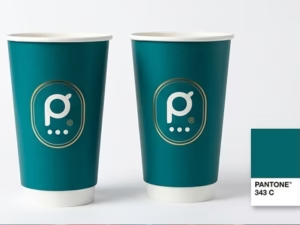
The Pantone Matching System (PMS) is a globally standardised color language used by designers, manufacturers, and brand managers to ensure that a specific color is reproduced identically everywhere in the world, regardless of the printing process, material, or geography. Each Pantone color has a unique number and is mixed from a precise ink formulation — it is not approximated by combining CMYK dots.
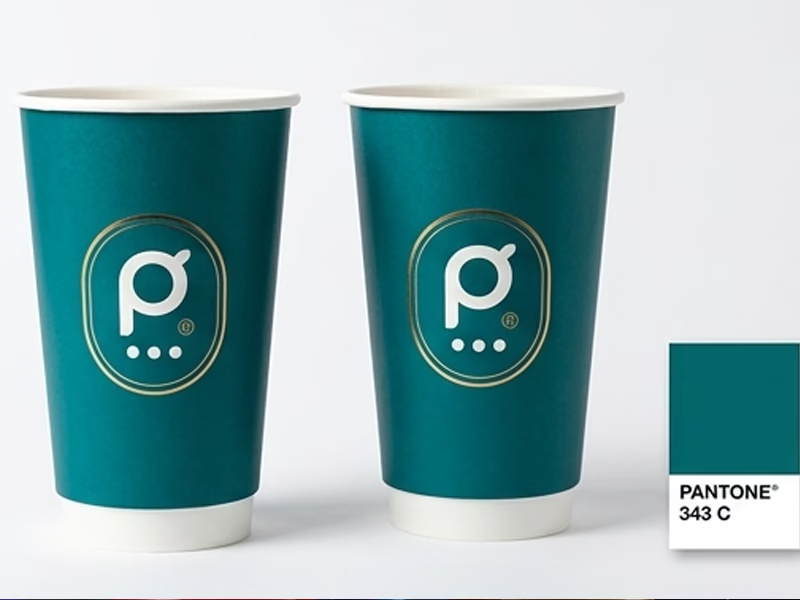
When a brand specifies “Pantone 485 C” for their red, they can trust that the cups manufactured in China will match the packaging produced in Germany and the napkins printed in the United States. That consistency is priceless for global and franchise brands.
This is why companies such as Starbucks (their iconic green, Pantone 3425), Coca-Cola (Pantone 485), and McDonald’s (Pantone 109 yellow) rely on strict PMS color control across all their packaging formats worldwide. A half-shade difference in brand color across franchise locations undermines years of visual equity building.
Advantages of Pantone Printing
✓ Strengths
- Exact, repeatable color across all print runs
- Reproduces colors impossible to achieve with CMYK (fluorescents, certain blues and greens)
- Essential for brand identity protection and franchise consistency
- Works on paper, cardboard, plastic, and specialty substrates
- A designer-selected PMS reference eliminates guesswork
⚠ Limitations
- Each additional Pantone color adds cost — a two-color design is typically more affordable than four-color
- Not suitable for complex photographic images (use CMYK for that)
- Requires higher minimum order quantities than digital methods
- Longer setup time due to custom ink mixing
Best Applications for Food Packaging
Franchise coffee chains
Bubble tea brand cups
Corporate identity packaging
Simple logo-heavy designs
Brand-critical color matching
Nationwide rollout packaging
💡
FHQPAK Insight: If your brand guidelines specify a Pantone reference, always communicate that number to your packaging supplier before approving artwork. Never rely on the CMYK conversion of a Pantone color — the difference can be significant on the final printed cup.
What Is UV Printing?
UV printing uses ultraviolet light to instantly cure (harden) special UV-reactive inks the moment they are applied to the substrate. Unlike traditional inks that dry through absorption or evaporation, UV inks are locked in place by a photochemical reaction triggered by UV lamps integrated into the printing unit. The result is a print that is immediately dry, highly durable, and capable of vibrant detail on a wide variety of surfaces.
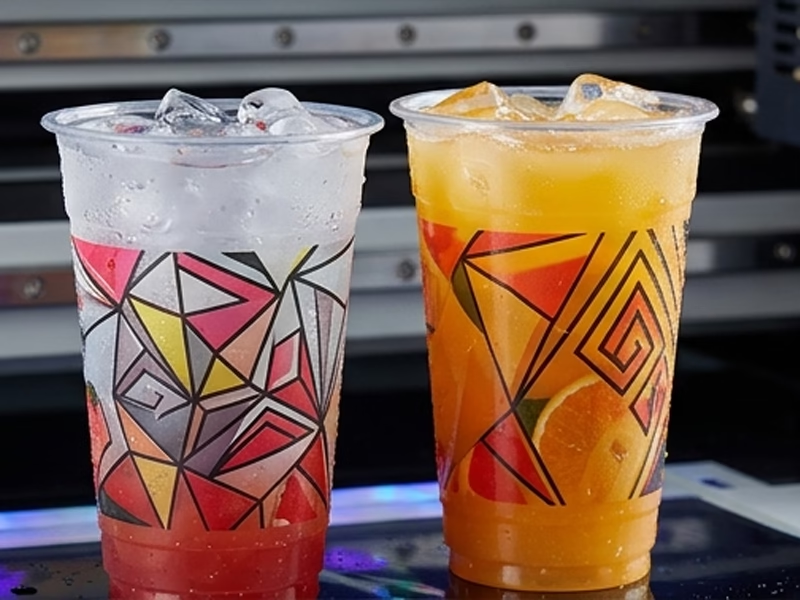
UV printing is particularly popular for premium packaging where visual impact is paramount — thick ink deposits create tactile finishes, and the absence of solvents allows printing directly on non-porous surfaces such as plastics, PET cups, and metal.
Advantages of UV Printing
✓ Strengths
- Exceptional colour vibrancy and sharpness — inks sit on the surface rather than absorbing
- Instantly cured — no waiting time, no smearing
- Can print on rigid plastics, PET, PP, glass, and non-traditional substrates
- Creates premium effects: raised texture, spot gloss, matte-gloss contrast
- Highly durable — resistant to moisture, scratches, and UV fading
- No minimum order quantity restrictions for digital UV flatbed systems
⚠ Limitations
- Higher per-unit cost than CMYK offset for large volumes
- Special UV inks required — not all suppliers have the equipment
- On flexible substrates, UV inks can crack if the material is bent significantly
- Food-contact compliance requirements must be verified for direct-contact surfaces
Best Applications for Food Packaging
Premium PET cup branding
Small batch customisation
Spot gloss effects
Rigid food container printing
High-end gift packaging
Event and pop-up branding
What Is UV Transfer Printing?
UV Transfer Printing — also known as UV DTF (Direct-to-Film) printing — is a newer technology that combines UV printing with a transfer film process. The design is first printed onto a special release film using UV inks, then a laminate layer is applied over the print, and finally the resulting “sticker” is transferred directly onto the target surface by hand or with a small press. No heat or moisture is required for application.
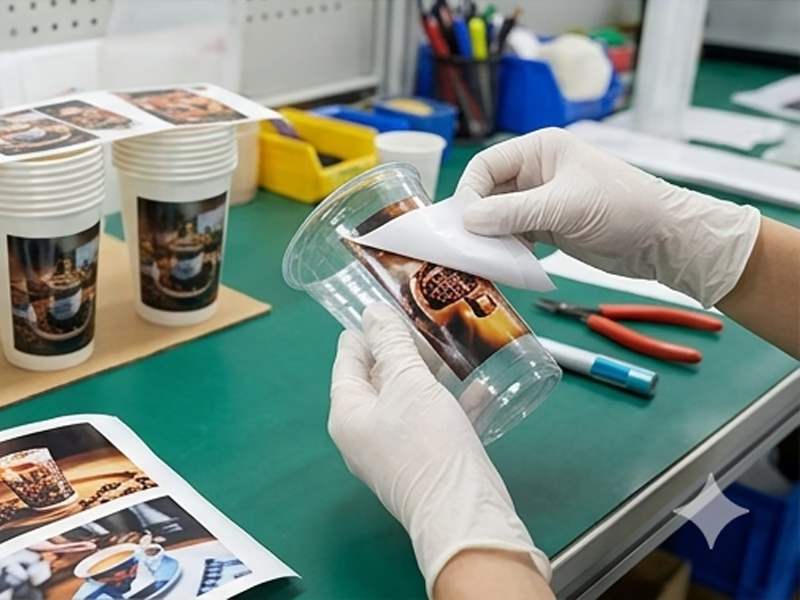
This makes UV transfer ideal for customising surfaces that are difficult to print on directly — curved PET cups, textured containers, and irregularly shaped packaging. It is also extremely practical for small and ultra-small batch runs, since no printing plates or setup are required: you can order 50 pieces or 500 pieces with the same efficiency.
Advantages of UV Transfer Printing
✓ Strengths
- No minimum order quantity — single pieces are economically viable
- Works on curved, textured, and non-flat surfaces
- Ultra-fast production — artwork to finished product in hours
- Photographic quality with gloss finish and precise detail
- No printing plates required — ideal for frequently changing designs
- Cold application — no heat required, safe for heat-sensitive plastics
⚠ Limitations
- Higher per-unit cost at very large volumes compared to offset CMYK
- Application is typically manual — scalability has limits
- Edges of transfer may be visible on close inspection
- Not ideal for full wrap-around coverage on large surfaces
Suitable Packaging Products
PET cold cups
PP plastic cups
Promotional packaging
Sample and prototype runs
Event cups & limited editions
Personalised food containers
🚀
FHQPAK’s Small-Batch Advantage: UV transfer printing is where our rapid-response capability truly shines. We can take a client from approved artwork to finished printed cups in as little as 24–48 hours. For pop-up events, seasonal launches, or trial orders, this is a game-changing option.
CMYK vs Pantone vs UV vs UV Transfer: Side-by-Side Comparison
Use this table as a quick reference when evaluating which printing method fits your project requirements.
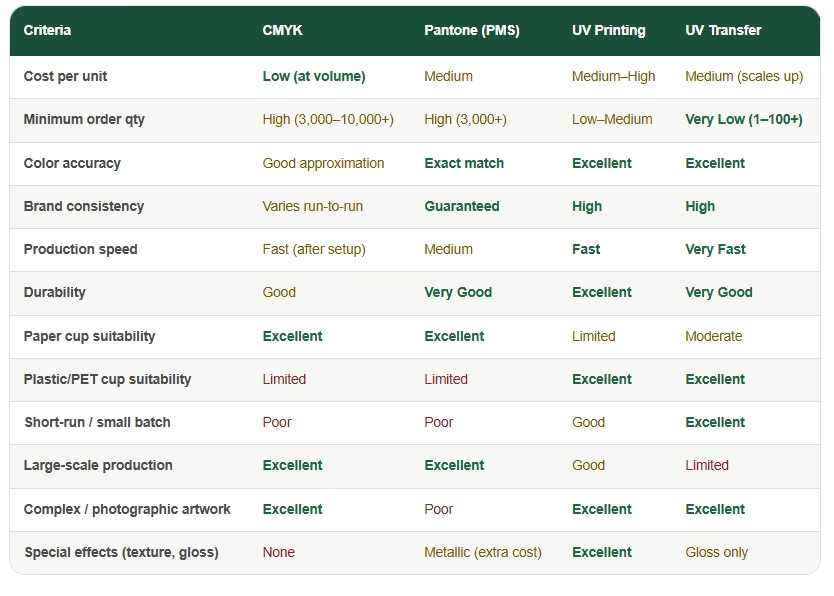
| Criteria | CMYK | Pantone (PMS) | UV Printing | UV Transfer |
|---|---|---|---|---|
| Cost per unit | Low (at volume) | Medium | Medium–High | Medium (scales up) |
| Minimum order qty | High (3,000–10,000+) | High (3,000+) | Low–Medium | Very Low (1–100+) |
| Color accuracy | Good approximation | Exact match | Excellent | Excellent |
| Brand consistency | Varies run-to-run | Guaranteed | High | High |
| Production speed | Fast (after setup) | Medium | Fast | Very Fast |
| Durability | Good | Very Good | Excellent | Very Good |
| Paper cup suitability | Excellent | Excellent | Limited | Moderate |
| Plastic/PET cup suitability | Limited | Limited | Excellent | Excellent |
| Short-run / small batch | Poor | Poor | Good | Excellent |
| Large-scale production | Excellent | Excellent | Good | Limited |
| Complex / photographic artwork | Excellent | Poor | Excellent | Excellent |
| Special effects (texture, gloss) | None | Metallic (extra cost) | Excellent | Gloss only |
How to Choose the Right Printing Method for Your Packaging Project
The right printing method depends on four factors: your artwork complexity, your order volume, your brand color requirements, and your timeline. Here is a clear framework.
Choose CMYK When…
- Your design includes photos, gradients, or many colors
- You are ordering 5,000+ pieces per SKU
- Cost efficiency at scale is the priority
- You are printing on paper cups, boxes, or bowls
- Exact color matching is not critical
Choose Pantone When…
- Your brand guidelines specify a PMS color
- You operate a franchise or multi-location business
- Color consistency across batches and suppliers is mandatory
- Your design is logo-led with limited colors (1–4 spot colors)
- You need to match packaging to other brand materials
Choose UV Printing When…
- You need to print directly on PET or PP plastic cups
- You want premium tactile effects (raised gloss, matte-gloss contrast)
- High durability is required (moisture, heat resistance)
- Medium-volume runs with vivid color impact
- Your packaging uses non-porous or rigid substrates
Choose UV Transfer When…
- You need a small batch of 50–500 pieces urgently
- You are running a pop-up, event, or product launch
- You want to customise clear PET cups with full-color designs
- You need same-week or even same-day turnaround
- You are testing a design before committing to a larger run
Many businesses use a combination of methods: UV Transfer for initial market testing and event samples, then scaling up to CMYK offset for ongoing production once designs are finalised and sales are confirmed.
Common Mistakes Customers Make When Ordering Custom Printed Packaging
After years of working with coffee shops, bubble tea brands, and restaurant groups, these are the most common — and most costly — printing mistakes we see.
1
Submitting artwork in RGB color mode
RGB is a screen color space (used by monitors and cameras). Printing presses use CMYK. When an RGB file is converted to CMYK without a designer’s intervention, colors shift — often dramatically. Blues become purpler, vivid oranges become muddier.Fix → Always submit artwork files pre-converted to CMYK in Adobe Illustrator, Photoshop, or InDesign before sending to your supplier.
2
Not specifying Pantone references for brand colors
Telling a supplier “our red is the same as Coca-Cola” or attaching a JPEG of your logo is not a reliable color reference. Every screen displays differently.Fix → Check your brand guidelines and list the exact Pantone Coated (C) or Uncoated (U) reference for every brand color. If you do not have Pantone references, work with a designer to establish them from the Pantone selector book.
3
Ignoring natural color variation in paper substrates
The base color of paperboard is off-white to cream, not bright white. Colors printed on paper cups will appear slightly warmer than on screen. A “pure white” background in your artwork will show the paper’s natural tone.Fix → Request a physical printed sample before approving mass production. Review the sample under natural light conditions, not just under studio lighting.
4
Using the wrong printing process for plastic cups
Standard CMYK offset printing requires a flat, absorbent surface. PET and PP clear cups are curved and non-porous — standard offset inks will not adhere properly. Many customers order printed clear cups via offset suppliers and receive peeling, cracking prints.Fix → For PET and PP cups, specify UV printing or UV Transfer printing. Always confirm your supplier’s process for plastic substrates.
5
Designing with very small text or ultra-fine lines
Text below 6pt and line strokes thinner than 0.25pt may look crisp on screen but become illegible or disappear entirely when printed at production scale on packaging material, especially on textured or curved surfaces.Fix → Use a minimum of 7–8pt for any text intended to be readable. Increase stroke weights for fine graphic elements. When in doubt, ask your supplier to print a digital proof at 1:1 scale.
FHQPAK’s Printing Capabilities
FHQPAK specialises in custom food packaging with a distinct advantage: we support small-batch orders with rapid response times — from artwork approval to finished goods faster than most large-scale factories will even schedule a production slot.
Products
Products
Products
PET cold cups (98mm, 90mm, 78mm+)
Products
Products
Products
Ice cream cups
Products
Products
Aluminium foil bags
Our printing services include:
Printing
CMYK process printing
Printing
Pantone color matching
Printing
UV printing for plastic substrates
Printing
UV Transfer / UV DTF
Service
Professional artwork support
Service
Physical sample approval
Service
Small-batch rapid dispatch
Service
Color matching consultation
⚡
Small batches, fast turnaround: We understand that not every order requires 10,000 units. FHQPAK’s production workflow is specifically built to serve growing brands and fast-moving businesses — sample orders, seasonal runs, and event packaging handled with the same care as full-scale production.
Conclusion
Choosing the right printing method for your custom food packaging is not a one-size-fits-all decision. CMYK remains the most economical choice for complex, full-colour artwork at high volumes. Pantone is non-negotiable for franchise brands and any business where color consistency is a strategic priority. UV printing delivers premium quality and durability for plastic substrates and specialty applications. UV Transfer printing is the fastest and most flexible option for small batches, rapid turnaround, and testing new designs.
The best packaging decisions are made early — before artwork is finalised, before quantities are committed, and before deadlines become crises. If you are planning a new packaging run and are unsure which printing method is right for your brand, substrate, or order size, the team at FHQPAK is ready to guide you through the process from the first conversation to the finished product on your shelf.
Ready to Print Your Custom Packaging?
Get expert advice on printing methods, materials, and minimum quantities for your specific packaging project — with fast turnaround for small and large batches alike.
Paper cups · PET cups · Food boxes · Aluminium bags · Custom packaging